Table of Contents
Introduction

An acrylic bathtub has become one of the most widely used bathtub options for modern residential bathrooms, hotels, apartments, villas, and other interior projects. Its popularity is not based on appearance alone. Acrylic allows manufacturers to produce a broad range of shapes and dimensions while maintaining a relatively manageable product weight, a smooth surface, and design flexibility that works well with contemporary bathroom layouts.
However, selecting an acrylic bathtub for a project involves more than comparing exterior styles. The quality of the acrylic surface, structural reinforcement, bathtub dimensions, interior geometry, installation conditions, drainage configuration, manufacturing consistency, and packaging all influence how the finished product performs once installed.
For distributors, bathroom brands, developers, architects, and project procurement teams, these considerations become even more important when dozens or hundreds of units need to maintain consistent dimensions and appearance. This guide explains how acrylic bathtubs are made, what separates a well-designed product from a basic one, and what buyers should evaluate before specifying a bathtub for a residential or commercial bathroom project.
What Is an Acrylic Bathtub?
An acrylic bathtub is generally formed from an acrylic-based sheet that is heated and shaped over a mold to create the bathtub shell. The shell is then reinforced and combined with supporting structural components to provide the strength required for regular use.
Acrylic materials belong to a wider family of polymers used in many manufactured products. One familiar acrylic material is poly(methyl methacrylate), commonly known as PMMA or acrylic. In bathtub manufacturing, the exact sheet structure and reinforcement system can vary between manufacturers, which is why the word “acrylic” by itself does not fully describe the quality of a finished bathtub.
The visible shell is only one part of the product. Beneath it, reinforcement, the supporting frame, adjustable feet, drain components, overflow fittings, and the connection between individual parts all contribute to stability.
This means two acrylic bathtubs with similar photographs can perform very differently when examined in detail.
Why Acrylic Is Widely Used for Modern Bathtubs
One reason acrylic is widely adopted is its design flexibility. Once the sheet is heated during the forming process, it can be shaped into oval, slipper, bowl-shaped, rectangular, back-to-wall, and other bathtub forms. Manufacturers can therefore develop collections for different bathroom sizes and design styles without being limited to a single traditional bathtub profile.
Its relatively low product weight is another advantage in many projects. Weight affects transportation, handling, positioning, and installation, particularly when bathtubs need to be moved into apartments, upper-floor hotel rooms, or completed interiors.
Surface characteristics also matter. A properly manufactured acrylic bathtub can provide a smooth and uniform finish suitable for minimalist bathroom spaces. White remains common, but different projects may require alternative colors or surface treatments to coordinate with vanities, basins, wall finishes, flooring, and bathroom hardware.
For procurement teams, however, these advantages should be treated as a starting point rather than an automatic indication of product quality. The material needs to work together with the entire bathtub structure.
Acrylic Bathtub Construction: What Buyers Should Examine
A bathtub needs to resist the combined load of water and the user without excessive movement. For that reason, evaluating the construction beneath the visible acrylic surface is important.
The shell should maintain its intended geometry after forming. Excessive variation can create problems around the rim, drain location, floor contact points, or installation interfaces. Reinforcement should support the shell in areas that experience mechanical loading rather than simply adding unnecessary material.
The supporting frame and feet also deserve attention. Their function is to distribute load and allow the bathtub to remain stable after positioning. On freestanding models, this becomes especially important because there is usually less surrounding construction available to conceal alignment problems.
Drain and overflow components should be considered at the same stage. A visually attractive bathtub that creates difficulties when installers connect drainage or service components can increase work on site.
For international projects, these details are best evaluated through technical drawings, samples, specifications, and pre-production communication rather than relying only on catalog images.
Acrylic Bathtub Thickness Is Not the Only Quality Indicator
Bathtub buyers often focus heavily on sheet thickness. It is certainly relevant, but treating thickness as the only measure of quality can be misleading.
A successful bathtub depends on the relationship between the acrylic shell, forming quality, reinforcement, base support, geometry, fittings, and production control. A thicker surface cannot compensate for weak support underneath the bathtub, just as strong reinforcement cannot fully correct an inaccurately formed shell.
Buyers should therefore evaluate the product as a complete structure.
This is particularly important in B2B sourcing because consistency between units can be as important as the performance of an individual sample. A hotel or apartment project may require many identical bathtubs. Small differences in dimensions, drainage positions, surface appearance, or support structures can create significant installation problems when multiplied across an entire project.
Acrylic Bathtub Shapes and Their Practical Differences
Bathtub shape influences much more than visual style. It affects usable bathing space, bathroom circulation, cleaning access, installation clearance, and compatibility with nearby fixtures.
Oval freestanding designs are popular in contemporary bathrooms because their curved profile creates a softer visual transition between the bathtub and surrounding space. They generally work well when the bathtub is intended to become a central design element.
Slipper bathtubs raise one or both ends of the bathtub and can create a more distinctive profile while supporting a reclined bathing position. Their height and silhouette, however, need to be considered carefully in compact rooms.
Back-to-wall bathtubs combine characteristics of freestanding and wall-adjacent installations. They can help reduce unused space behind the bathtub while retaining a contemporary exterior appearance.
More sculptural models may be appropriate for villas, luxury suites, wellness spaces, and design-led projects where the bathtub is part of the architectural composition rather than simply a functional bathroom fixture.
The right design therefore depends on both appearance and the way the room will actually be used.
Choosing the Right Acrylic Bathtub Size
Bathtub dimensions should be considered early in bathroom planning. A common mistake is to select a model according to available floor length while overlooking surrounding circulation space, faucet positioning, drainage locations, door movement, cleaning access, and the visual proportion of the room.
The following ranges illustrate how size selection can vary according to project conditions rather than acting as rigid standards:
| Bathroom Situation | Typical Bathtub Planning Range | Main Consideration |
|---|---|---|
| Compact bathroom | Around 1400–1600 mm | Preserve circulation and installation clearance |
| Standard residential bathroom | Around 1500–1700 mm | Balance comfort and room proportion |
| Hotel guest bathroom | Project-dependent | Standardization and installation efficiency |
| Large villa bathroom | Around 1700–1800 mm or more | Comfort and visual presence |
| Custom project | Specified by drawing | Coordinate architecture, plumbing and fixtures |
Actual model dimensions must always be confirmed from the manufacturer’s technical drawings.
For example, THEO’s oval acrylic freestanding bathtub AJ6601 is available in 1500 × 800 × 585 mm and 1700 × 850 × 585 mm versions. Offering more than one size within a design family allows similar visual language to be adapted to different bathroom layouts.
The important lesson is that bathtub selection should start from room conditions and project requirements instead of assuming that one dimension is suitable for every installation.
Interior Dimensions Matter as Much as Exterior Dimensions
Exterior length is useful for determining whether a bathtub physically fits into a bathroom, but it does not tell the complete comfort story.
Two models with the same external length can provide noticeably different internal bathing space because of wall thickness, backrest angle, rim width, base geometry, and the shape of the foot end.
A bathtub with an aggressively inclined backrest may feel comfortable for reclining but provide less usable base length. A model with thick sculptural rims may create a strong visual effect but reduce interior width. Deeper tubs can create a more immersive soaking experience while also affecting entry height and total water volume.
For this reason, architects and project buyers should review sectional drawings or physical samples where possible rather than making decisions from overall length alone.
Freestanding Acrylic Bathtub vs Built-In Bathtub
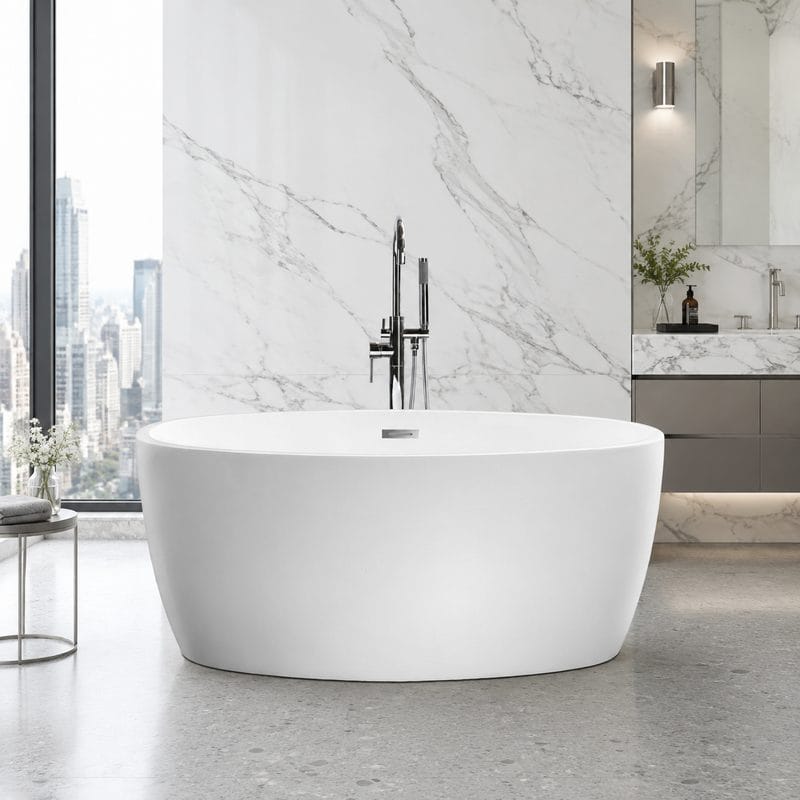
Freestanding designs have become prominent in contemporary bathroom projects because they can function as both sanitary fixtures and visual focal points. They allow designers to create more open layouts and can work particularly well in larger residential bathrooms, hotel suites, villas, and wellness-oriented interiors.
Built-in bathtubs serve a different purpose. They can make efficient use of wall zones and may integrate naturally into compact bathrooms where surrounding surfaces are already part of the architectural design.
Neither format is automatically better. The correct choice depends on the project.
A freestanding acrylic bathtub normally requires careful coordination of floor drainage, faucet location, access around the bathtub, and the relationship between the fixture and the room. Built-in designs require equally careful coordination between the bathtub and surrounding construction.
Project teams should therefore choose installation format during bathroom planning instead of treating the bathtub as a product to be added after the room has already been designed.
Matching the Bathtub With a Freestanding Tub Filler
When a freestanding bathtub is selected, faucet planning becomes particularly important.
The filler must be positioned so that water enters the bathtub correctly while providing sufficient clearance between the spout, bathtub rim, and surrounding surfaces. Floor-mounted fillers can create an elegant installation, but their rough-in position should be coordinated before the finished floor is completed.
The relationship between faucet height and bathtub rim height also matters. If these elements are considered independently, an otherwise attractive combination may look poorly proportioned or create inconvenient installation conditions.
This is one reason complete bathroom planning is useful for larger developments. THEO’s bathroom project solutions combine bathtub selection with pedestal basins, bathroom vanities, and matching accessories so dimensions, finishes, and installation conditions can be considered as part of the same project rather than as isolated purchasing decisions.
Surface Finish and Color Selection
Glossy white acrylic remains widely used because it integrates easily with many bathroom styles and tends to create a clean, bright appearance. However, modern projects increasingly use different surface effects and coordinated material palettes.
Matte surfaces can contribute to a softer architectural appearance, while custom colors may help designers coordinate a bathtub with stone surfaces, wall panels, cabinetry, metal finishes, or brand-specific interiors.
Any departure from standard finishes should be discussed early with the manufacturer. Color consistency, minimum production requirements, production method, cleaning characteristics, and sample approval may all influence the final specification.
For distributors and private-label brands, consistency between production batches is particularly important. A color that looks attractive on one sample must also be reproducible when the design moves into regular production.
Acrylic Bathtub Quality Control for Project Orders
Quality control becomes more complex as order volume increases. Inspecting only whether a bathtub looks acceptable from a distance is not enough for a project.
Dimensional consistency should be checked because repeated installation depends on predictable measurements. Surface inspection should identify visible defects, irregular polishing, color inconsistency, scratches, or deformation. Drain and overflow positions should correspond to approved drawings, while frames and supporting components need to be correctly installed.
Packaging is also part of quality control.
A bathtub may leave the production line in good condition but still arrive damaged if exposed surfaces and edges are inadequately protected during international transportation. Protective film, foam positioning, inner wrapping, carton structure, and loading methods therefore contribute to the real delivered quality of the product.
For hotel, apartment, and residential development projects, production inspection and packaging planning should be treated as part of the purchasing specification rather than tasks considered only after manufacturing has finished.
What to Consider When Comparing Acrylic Bathtub Suppliers
A buyer sourcing acrylic bathtubs for distribution or a project should look beyond product photography and individual specifications.
Manufacturing capability matters because a supplier needs to reproduce approved designs consistently. Product development capability is also important when dimensions, colors, packaging, fittings, branding, or molds need modification.
Technical documentation helps architects and installers plan correctly. Certifications may be required for particular markets, while sample development allows buyers to confirm surface quality, proportions, fittings, and packaging before larger-scale production.
Communication is equally important. Bathroom products interact with plumbing systems, room layouts, furniture, flooring, and other fixtures. Misunderstandings during specification can therefore create problems far beyond the bathtub itself.
A capable supplier should be able to discuss the complete product rather than simply provide an exterior dimension and product photograph.
When Does a Custom Acrylic Bathtub Make Sense?
Standard models cover many projects, but customization becomes useful when a brand or development has requirements that cannot be addressed efficiently by existing products.
Customization may involve dimensions, exterior shape, surface color, finish, drain configuration, fittings, packaging, branding, or entirely new mold development. The appropriate degree of customization depends on project volume, technical feasibility, intended market, and development schedule.
Private-label brands may use customization to differentiate a collection. Hotel groups may need products adapted to standardized room layouts. Developers may need dimensions adjusted to architectural constraints, while distributors may want packaging and branding suited to their local market.
The key is to define these requirements before production starts. A clear specification reduces repeated changes and allows manufacturing, quality control, packaging, and installation planning to follow the same approved reference.
Acrylic Bathtubs in Hotel and Residential Projects
Residential customers often select a bathtub according to personal comfort and bathroom design. Project procurement works differently.
In a hotel, apartment development, or multi-unit residential project, a bathtub must fit repeated room layouts, coordinate with plumbing conditions, meet design requirements, and remain practical for installation and maintenance across many rooms.
Hotels may prioritize durability, ease of cleaning, consistent replacement specifications, and visual coordination with the overall interior concept. Apartment projects may focus more heavily on dimensional efficiency and standardized installation. Villas and premium residences may place greater emphasis on freestanding forms, deeper soaking space, distinctive silhouettes, and coordinated bathroom furniture.
These differences explain why one “best acrylic bathtub” does not exist for every application. Product selection should be based on the operating requirements of the specific project.
Common Acrylic Bathtub Selection Mistakes

Many bathtub problems originate during specification rather than manufacturing.
Choosing according to appearance alone can lead to a product that is visually attractive but poorly matched to the room. Selecting only by exterior length can overlook usable internal space. Ignoring faucet rough-in requirements can create installation conflicts, while failing to confirm drainage positions can require unnecessary site modifications.
Buyers can also underestimate packaging requirements for international transportation or fail to confirm whether the production model will match the approved sample in dimensions, fittings, finish, and structural support.
A more reliable process is to review the bathtub as part of the entire bathroom system. Architectural dimensions, plumbing, user comfort, accessories, transportation, installation, and maintenance should all influence the decision.
Conclusion
An acrylic bathtub offers a useful combination of design flexibility, manageable weight, smooth surface characteristics, and compatibility with many contemporary bathroom styles. These advantages make acrylic suitable for applications ranging from private homes and apartments to hotels, villas, and larger residential developments.
The material alone, however, does not determine whether a bathtub is suitable for a project. Shell forming, structural reinforcement, frame design, dimensions, internal geometry, drainage, surface consistency, accessories, quality control, packaging, and installation planning all contribute to the final result.
For professional buyers, the most effective selection process is therefore not simply to ask which acrylic bathtub looks best. It is to determine which model fits the room, user requirements, installation method, project standards, design language, and supply requirements at the same time.
A carefully specified acrylic bathtub can then become more than an individual bathroom fixture. It can form part of a coordinated bathroom solution that is easier to manufacture consistently, install correctly, maintain over time, and reproduce across future projects.
FAQ
What is an acrylic bathtub?
An acrylic bathtub is a bathtub produced using an acrylic-based surface shell that is formed into the required shape and combined with structural reinforcement and supporting components. Different manufacturers may use different sheet structures, reinforcement methods, frames, and fittings, so finished product quality should be evaluated as a complete system rather than by material name alone.
Are acrylic bathtubs suitable for hotel projects?
Yes. Acrylic bathtubs can be used in hotel projects when the selected model meets the required dimensions, structural performance, installation conditions, maintenance requirements, and relevant market standards. For multi-room developments, dimensional consistency and repeatable production are particularly important.
What size acrylic bathtub should I choose?
The appropriate size depends on available bathroom space, user requirements, installation clearance, faucet positioning, drainage, and the desired internal bathing area. Exterior dimensions should always be checked together with technical drawings and room plans before final selection.
What should buyers inspect when evaluating acrylic bathtub quality?
Buyers should consider surface finish, forming accuracy, reinforcement, frame stability, adjustable support, drain and overflow installation, dimensional consistency, accessories, production inspection, and packaging. Looking only at acrylic thickness or exterior appearance provides an incomplete assessment.
Can an acrylic bathtub be customized?
Depending on the manufacturer and project requirements, customization can include size, shape, color, surface finish, fittings, packaging, branding, and new product development. Technical feasibility and project volume should be discussed before a custom design enters production.